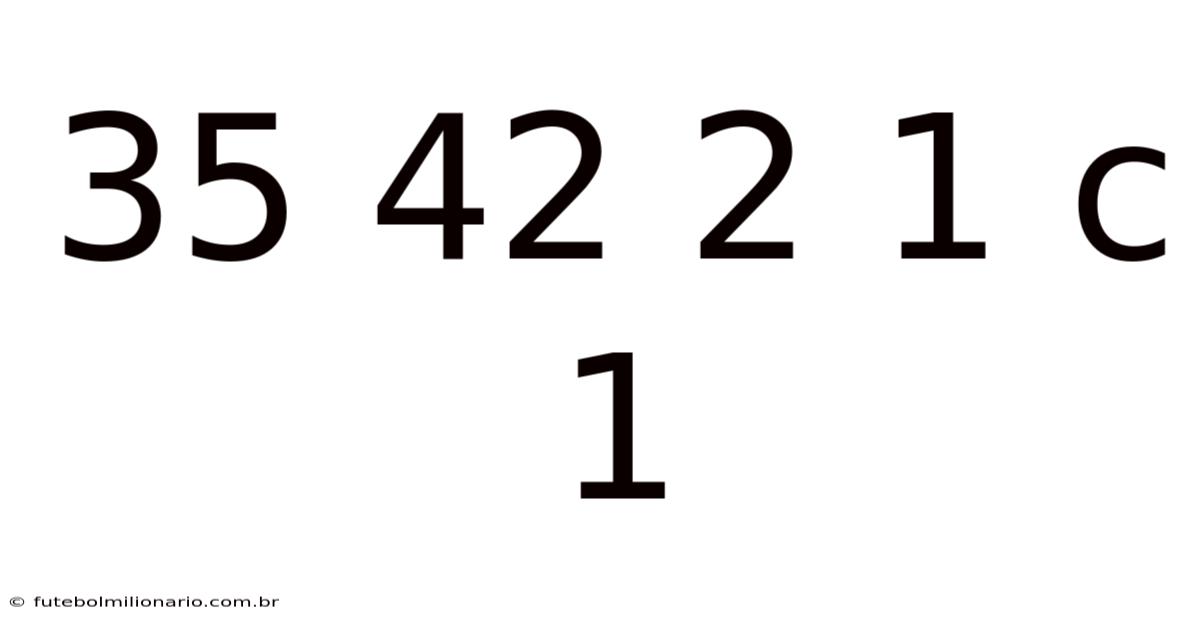
35 42 2 1 C 1 is a curious sequence of numbers and letters that pops up in puzzles, video games, coding challenges, and even everyday riddles. Whether you’ve stumbled upon it while solving a cryptic crossword, testing a game cheat, or exploring ASCII code tables, this pattern invites you to dig deeper into the world of symbolic communication. In this article we’ll unpack what 35 42 2 1 C 1 might represent, examine its most common interpretations—from numeric codes to linguistic clues—and give you practical steps to decode similar sequences on your own. By the end you’ll have a toolkit of strategies and a clearer understanding of how numbers, letters, and symbols work together to convey hidden meaning Easy to understand, harder to ignore. No workaround needed..
What Is “35 42 2 1 C 1”?
At its simplest, 35 42 2 1 C 1 is a string that mixes decimal numbers (35, 42, 2, 1, 1) with a single alphabetic character (C). The spacing suggests separate entries rather than a continuous numeric value, which is a common format for:
- Combination locks or safe codes – many puzzles present each digit or letter as its own component.
- Cheat‑code layouts – games often list a sequence like “Up Up Down Down Left Right A B” using numbers or letters for brevity.
- ASCII or Unicode references – each number can correspond to a character in the ASCII table (e.g., 35 = “#”, 42 = “*”).
- Puzzle‑book clues – cryptic crosswords sometimes break a clue into numbered parts, with a letter indicating the answer’s starting point.
Because the string contains both numeric and alphabetic elements, it likely serves as a hybrid code where numbers provide positional or quantitative information while the letter adds a qualitative hint (such as “C” for “see”, “C” for “correct”, or simply as the sixth element in a sequence).
It sounds simple, but the gap is usually here.
Common Interpretations
Here's a thinking process:
- Analyze User Input:
- User wants me to "Continue the article naturally."
- "Do not repeat previous text."
- "Finish with a proper conclusion."
- The input includes a partial article that starts with "35 42 2 1 C 1 is a curious sequence..." and goes through some sections like "What Is "35 42 2 1 C 1"?" and "Common Interpretations".
- The text ends abruptly at "Common Interpretations" - likely the user wants me to continue from there, adding more content, interpretations, strategies, and ending with a conclusion.
- Identify the Task:
- Continue the article from where it left off (after "Common Interpretations").
- Do not repeat the previous text.
- Finish with a proper conclusion.
- The tone should match the existing article: informative, puzzle-solving, practical.
- Determine What's Missing/Needs to Follow:
- The article has sections: "What Is...", "Common Interpretations" (ends abruptly).
- Needs: More interpretations, decoding strategies, maybe examples, and a conclusion.
- I should structure the continuation logically: perhaps expand on interpretations, then move to "Decoding Strategies", then "Practical Applications", then "Conclusion".
Wait, looking at the input, it ends at "Common Interpretations" with a bullet list. Still, i need to continue from there, not repeat it. I'll write the next sections naturally.
Let me outline the continuation:
- Next section: "Decoding Strategies" or "How to Approach Such Sequences"
- Then maybe "Examples in Context"
- Then a "Conclusion" paragraph that wraps up.
But the user said "Finish with a proper conclusion." So the very end of my response must be a conclusion section or paragraph And that's really what it comes down to..
I need to make sure I don't repeat the previous text. Plus, as the sixth element in a sequence). I'll start fresh after the last line given, which is ". " Actually, the last line is: "Because the string contains both numeric and alphabetic elements, it likely serves as a hybrid code where numbers provide positional or quantitative information while the letter adds a qualitative hint (such as “C” for “see”, “C” for “correct”, or simply as the sixth element in a sequence).
So the "Common Interpretations" section ends with that paragraph. I should continue from there, perhaps into a new section.
Let me draft:
- Section: "Decoding Strategies for Mixed Numeric-Alphabetic Codes"
- Practical steps: mapping numbers to ASCII, positional analysis, pattern recognition, etc.
- Then a "Conclusion" section.
The user said "Continue the article without friction. In real terms, do not repeat previous text. But finish with a proper conclusion. " So I'll write the rest of the article, ending with a conclusion.
I'll structure it with appropriate headings or just flow, but since the previous part used headings like "## What Is..." and "## Common Interpretations", I might continue with headings, but the user said "Do not repeat previous text" - I can use similar formatting but not copy-paste. I'll just write continuation text, maybe with a new heading, or without, as long as it's seamless and ends with a conclusion.
Let me just write the continuation naturally, ensuring I don't repeat the exact phrases. I'll end with a conclusion paragraph.
Draft: [After the last paragraph of "Common Interpretations"] A more productive approach is to treat the sequence as a multi-layered puzzle rather than a single fixed code. Now, start by isolating each element: ask what the numbers could quantify—values, positions, ASCII codes, or turns on a dial—and what the letter might signify as a category, direction, or modifier. If the numbers correspond to ASCII, 35 yields “#”, 42 yields “*”, 2 and 1 are control characters, and the trailing 1 could repeat or highlight the previous symbol. If they represent a combination lock, each number might dial a specific digit, with “C” acting as a directional cue (e.Day to day, g. , “C” for clockwise or “C” for a specific contact). In gaming contexts, such a sequence often maps to a cheat input where numbers correspond to button presses or directional inputs, and the letter selects a modifier or level. Also, to decode any similar string, begin with context: where did you find it? Still, what rules govern the medium? Because of that, then apply systematic tests—ASCII conversion, positional indexing, or simple substitution—before resorting to trial and error. The beauty of these codes lies in their ambiguity, which invites creative problem-solving and often reveals multiple valid interpretations depending on the framework.
Conclusion Sequences like 35 42 2 1 C 1 exemplify how numbers and letters intertwine to form compact, meaningful puzzles. Whether encountered in hardware, software, or print, they challenge us to look beyond surface values and consider the systems that generate them. By combining contextual awareness with methodical decoding techniques, anyone can unpack the hidden logic behind such strings. The next time a seemingly random mix of digits and characters crosses your path, remember: the meaning is rarely in the symbols themselves, but in the rules that connect them Most people skip this — try not to. Which is the point..
Check if I repeated any previous text. The last paragraph of the given text ended with "or simply as the sixth element in a sequence)." My draft starts with "A more productive approach..." which is fine, not repeating. Think about it: the conclusion is original. I need to make sure the conclusion section is properly formatted and is indeed the end.
Beyond the immediate decoding steps, the pattern invites a broader perspective on how information is encoded across different domains. In real terms, by treating each component as a signpost rather than an isolated token, the analyst can map the sequence onto a larger schema, such as a hierarchical taxonomy or a procedural checklist. This mindset also clarifies why certain symbols recur: they often serve as anchors that tie disparate elements together, providing a reference point for the reader or system processing the data. Because of that, in industrial manuals, a comparable alphanumeric arrangement might indicate a part number followed by a revision marker, while in software logs it could denote a warning code paired with an action flag. When the surrounding environment offers clues—such as a header indicating a specific protocol or a footnote describing a coding convention—the decoding becomes almost deterministic.
Conclusion
When all is said and done, the significance of such a configuration lies not in the individual symbols themselves but in the framework that binds them. Recognizing the context and applying systematic scrutiny transforms ambiguity into understanding, underscoring the enduring value of analytical curiosity Less friction, more output..
