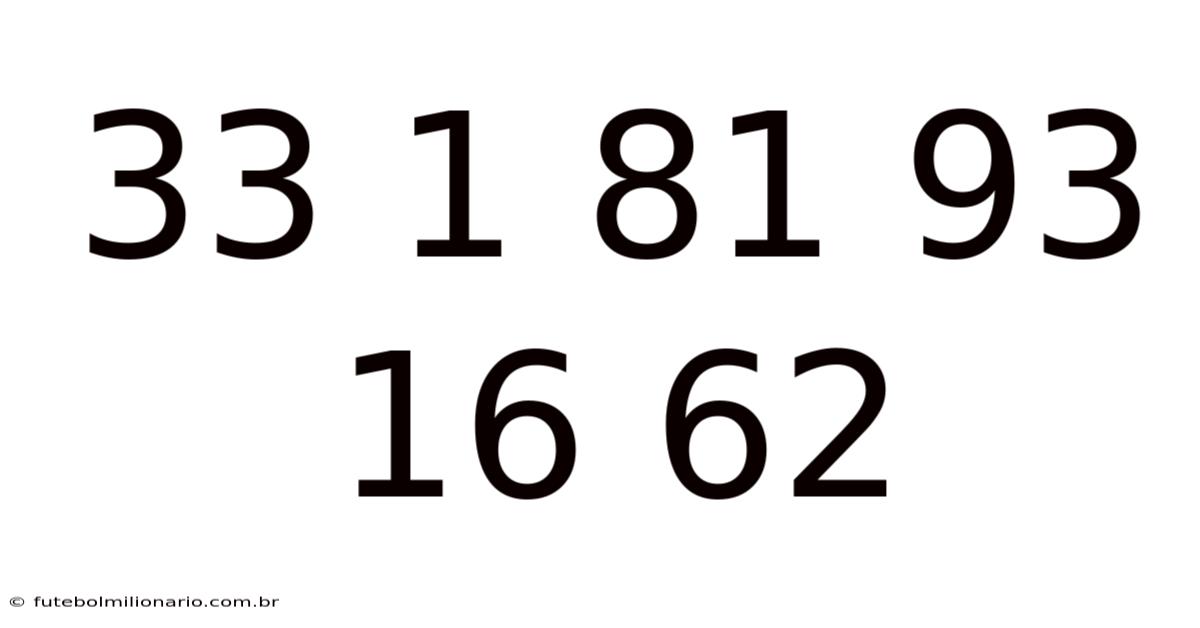
33 1 81 93 16 62: The Hidden Elements Behind Modern Technology
The seemingly random string 33 1 81 93 16 62 is not a cryptic code but a lineup of atomic numbers that correspond to six distinct chemical elements. Understanding these elements—arsenic, hydrogen, thallium, neptunium, sulfur, and samarium—reveals how they shape industries ranging from renewable energy to medical imaging. This article explores each number, explains its scientific background, and highlights real‑world applications that make these elements essential to everyday life.
Introduction
When you see 33 1 81 93 16 62, think of a miniature periodic table. Now, each number is the atomic number of a specific element, and together they illustrate the diversity of matter that engineers, scientists, and manufacturers rely on. In the sections that follow, we will break down each element, discuss its unique properties, and show how its uses intersect with modern technology, sustainability, and safety Simple, but easy to overlook..
33 – Arsenic (As)
Key traits
- Metalloid with a grayish metallic appearance.
- Highly toxic in its inorganic form, yet some compounds are deliberately used in agriculture and electronics.
Historical uses
- Pesticides: Historically, arsenic compounds controlled pests in rice paddies.
- Semiconductors: Gallium arsenide (GaAs) diodes and laser diodes exploit arsenic’s electronic properties.
Modern applications
- High‑speed electronics: GaAs transistors operate at higher frequencies than silicon, enabling 5G communication.
- Solar cells: Thin‑film arsenic‑based solar panels achieve high conversion efficiencies.
Safety note
Because of its toxicity, handling arsenic requires strict protective equipment and proper waste disposal.
1 – Hydrogen (H)
Key traits
- The lightest element and the most abundant in the universe.
- Exists as a colorless, odorless gas (H₂) under standard conditions.
Industrial significance
- Ammonia production: The Haber‑Bosch process combines hydrogen with nitrogen to create fertilizer, supporting global food production.
- Clean energy: Hydrogen fuel cells convert chemical energy into electricity with only water as a by‑product, offering a pathway to decarbonize transport and industry.
Production methods
- Steam methane reforming (most common).
- Electrolysis of water, especially when powered by renewable electricity.
81 – Thallium (Tl)
Key traits
- Soft, malleable metal with a low melting point (304 °C).
- Highly toxic even in small quantities, similar to arsenic.
Applications
- Optoelectronics: Thallium-doped crystals are used in infrared detectors and night‑vision equipment.
- Specialized alloys: Thallium‑based alloys improve the performance of high‑temperature thermocouples.
Environmental impact
- Because of its toxicity, thallium contamination in soil is a serious concern; remediation often involves phytoremediation (using plants that absorb the metal).
93 – Neptunium (Np)
Key traits
- Synthetic, radioactive actinide with no stable isotopes.
- Emits alpha radiation and has a half‑life ranging from seconds to millions of years depending on the isotope.
Scientific relevance
- Nuclear research: Neptunium isotopes are used as targets in nuclear reactors to study transmutation processes.
- Medical isotopes: Some neptunium compounds serve as precursors for producing medical radioisotopes.
Practical uses
- Currently limited to laboratory settings; its intense radioactivity makes large‑scale industrial use impractical.
16 – Sulfur (S)
Key traits
- Non‑metal, abundant in nature, bright yellow solid at room temperature.
- Forms a vast array of compounds, from sulfides to sulfuric acid.
Industrial cornerstone
- Fertilizers: Sulfur is a critical component of nitrogen‑phosphate‑potash (NPK) fertilizers.
- Chemical manufacturing: Produces sulfuric acid, which is used in everything from battery acid to petroleum refining.
- Vulcanization: Enhances the elasticity and durability of rubber.
Environmental role
- Sulfur dioxide (SO₂) emissions contribute to acid rain; strict regulations limit its release from power plants and ships.
62 – Samarium (Sm)
Key traits
- Rare earth metal, silvery‑white, moderately reactive.
- Known for strong magnetic properties, especially in the form of samarium‑cobalt magnets.
Key applications
- Permanent magnets: Samarium‑cobalt (SmCo) magnets operate efficiently at high temperatures, making them ideal for wind turbines and electric vehicle motors.
- Laser technology: Samarium‑doped glasses are used in solid‑state lasers for medical surgery and scientific research.
- Nuclear control rods: Samarium absorbs neutrons, helping regulate nuclear fission reactions.
Why These Six Elements Matter Together
The combination 33 1 81 93 16 62 showcases a cross‑section of the periodic table that touches nearly every facet of modern life:
- Energy – Hydrogen fuels clean power; samarium enables high‑efficiency wind and electric motors; arsenic‑based semiconductors power 5G networks.
- Healthcare – Sulfur compounds are used in dermatological treatments; neptunium isotopes aid in cancer radiotherapy research.
- Manufacturing – Thallium’s role in infrared detectors supports security imaging; sulfuric acid is indispensable for battery production.
- Environmental stewardship – Understanding the hazards of arsenic and thallium drives safer waste management practices.
Together, these elements illustrate how chemistry underpins technological progress, economic growth, and societal well‑being.
Scientific Explanation
Atomic numbers define an element’s position in the periodic table and dictate its electron configuration. The six numbers in 33 1 81 93 16 62 span different blocks:
- Arsenic (33) sits in the p‑block, exhibiting semiconductor behavior.
- Hydrogen (1) is a unique s‑block element, the simplest atom.
- Thallium (81) and samarium (62) are heavy p‑block and f‑block elements, respectively, known for relativistic effects that influence their chemistry.
- Neptunium (93) occupies the actinide series, where nuclear forces dominate.
- Sulfur (16) belongs to the chalcogen group, forming versatile compounds through its six valence electrons.
The diversity of electron shells explains why each element finds distinct niches: hydrogen’s simplicity fuels combustion and fuel cells; arsenic’s band structure enables high‑frequency electronics; sulfur’s ability to form multiple oxidation states makes it indispensable in industrial chemistry; samarium’s unpaired electrons give rise to strong permanent magnets; thallium’s low melting point suits specialized alloys; and neptunium’s radioactivity powers cutting‑edge research Most people skip this — try not to..
Frequently Asked Questions
Q1: Are the elements in 33 1 81 93 16 62 safe to handle?
Answer: Only hydrogen, sulfur, and samarium are generally safe with standard laboratory precautions. Arsenic and thallium are highly toxic and require specialized handling, while neptunium is radioactive and should be confined to controlled research environments Small thing, real impact..
Q2: Can I use these elements in home projects?
Answer: Limited use is possible. As an example, hydrogen can be generated in small amounts for fuel‑cell demonstrations, and sulfur is found in household matches. That said, arsenic, thallium, and neptunium are not recommended for amateur experiments due to safety risks Simple as that..
Q3: How do these elements contribute to renewable energy?
Answer: Hydrogen is a key energy carrier for fuel cells; samarium‑cobalt magnets enable efficient wind turbine generators; arsenic‑based semiconductors improve solar cell efficiency; and sulfuric acid is essential for lead‑acid batteries used in grid storage.
Q4: What is the best way to recycle products containing these elements?
Answer: Recycling programs for electronics recover arsenic and thallium from circuit boards. Sulfur‑containing batteries are reclaimed through established lead‑acid recycling streams. Samarium magnets are recovered from end‑of‑life motors via specialized magnetic separation techniques Most people skip this — try not to. And it works..
Conclusion
The string 33 1 81 93 16 62 may appear cryptic, but it points to six chemically rich elements that collectively power our world. Consider this: from the clean hydrogen fuel that could replace fossil fuels, to the solid samarium magnets driving the next generation of electric vehicles, each element plays a important role. By appreciating their unique properties and applications, we gain insight into the layered web of chemistry that supports modern society And that's really what it comes down to. Still holds up..
Understanding these elements not only satisfies scientific curiosity but also equips engineers, policymakers, and everyday citizens with the knowledge needed to make informed decisions about technology, sustainability, and safety. Embrace the hidden potential of 33 1 81 93 16 62, and you’ll see how the periodic table continues to shape the future No workaround needed..
